Blog
20 Years Since GRN-FTD Was Discovered: Honoring the Past, Fighting for the Future
📅
August 5, 2026
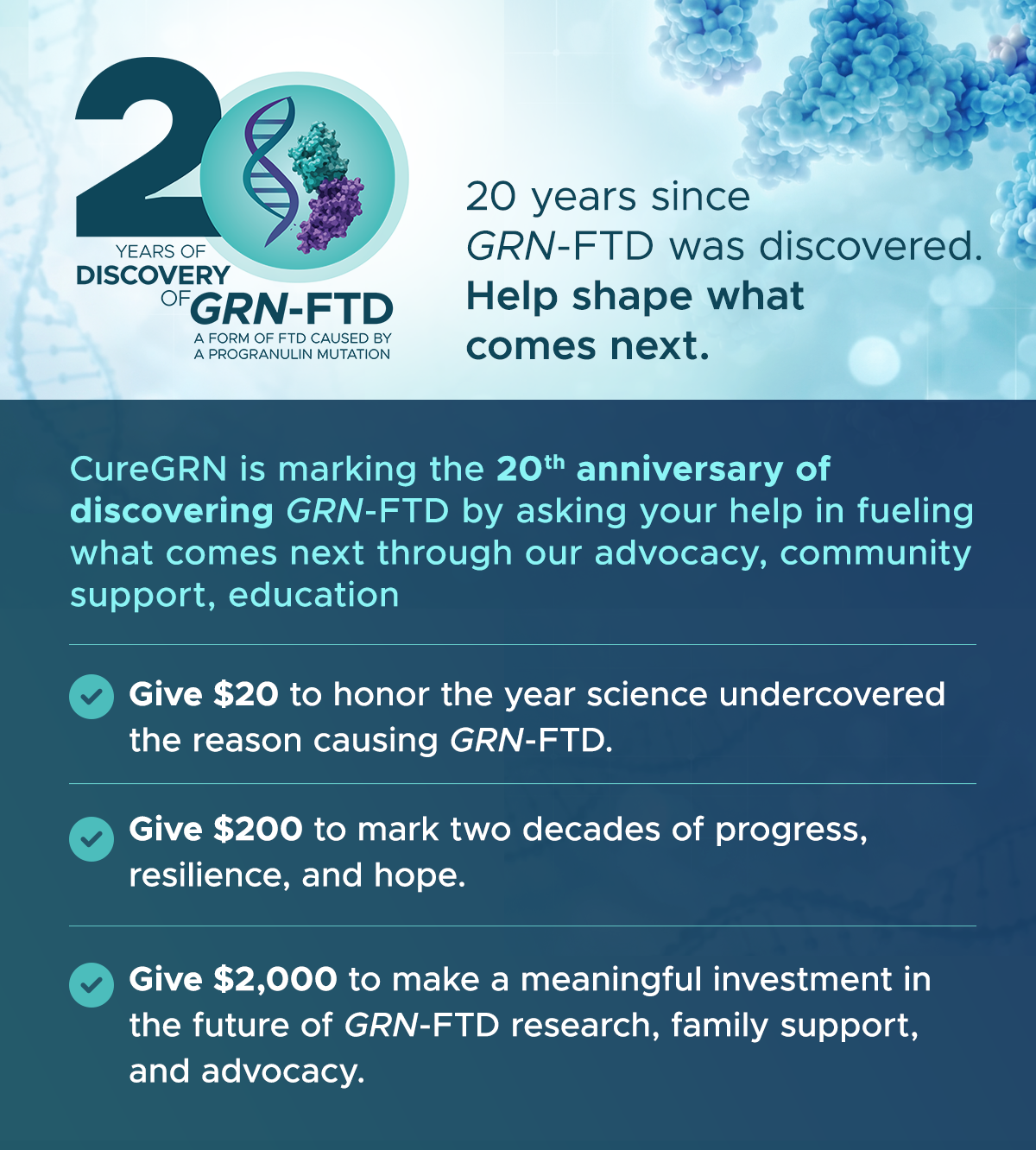
Twenty years ago, one scientific discovery forever changed the future for families affected by GRN-FTD.
In 2006, researchers identified mutations in the GRN (progranulin) gene as a cause of frontotemporal degeneration (FTD).
For many families, the discovery explained a disease that had haunted generation after generation. It also led some people with what appeared to be a sporadic diagnosis of FTD to learn that their disease was actually genetic, opening the door to genetic counseling, research participation, and a better understanding of risk. It gave researchers a new direction and families something they had never had before: hope.
Today, as we commemorate the 20th anniversary of this landmark discovery, we honor how far we've come and ask our community to help make further progress possible.
A Discovery That Changed Everything
Before 2006, scientists had a more limited understanding about the critical role of progranulin in the brain. Identifying GRN as a cause of FTD transformed the field, launching decades of research into why progranulin matters, how its loss leads to neurodegeneration, and how restoring it might change the course of this disease.
It also revealed an important truth: some people diagnosed with what appears to be a sporadic case of FTD actually have a genetic form of the disease. This can happen because a parent carrying a GRN mutation never developed symptoms, had protective genetic modifiers that delayed or prevented disease, or, more rarely, because the mutation occurred for the first time in that individual.
For researchers, the discovery opened an entirely new field of investigation. Scientists learned that progranulin plays a vital role in maintaining brain health, regulating inflammation, and supporting lysosomal function: the cell's recycling system. When progranulin levels are too low, neurodegeneration can follow.
Twenty Years of Progress
That single discovery has fueled two decades of significant scientific progress. Researchers now better understand:
- how progranulin supports brain and immune health
- how reduced progranulin disrupts lysosomal function
- how GRN mutations drive neuroinflammation and neurodegeneration
- biomarkers that may improve diagnosis and track disease progression
- gene therapies and other approaches designed to restore progranulin
Most importantly, there is now genuine momentum.
Researchers, clinicians, industry partners, advocates, and families have built an extraordinary foundation for developing effective treatments. Every study expands our understanding. Every clinical trial moves the field forward. Even when a clinical trial doesn't achieve its primary goal, it teaches researchers what to do next. Every study adds knowledge that shapes better therapies and brings us one step closer to a cure.
The cure for GRN-FTD is out there. Together, we can help find it.
Why CureGRN Matters
Scientific progress depends on more than discoveries in the laboratory. It depends on informed families, dedicated advocates, meaningful partnerships, and organizations that bring the community together while accelerating research.
With the support of families, donors, researchers, and advocates, CureGRN is helping to:
- Connect families with trusted education, resources, and support
- Raise awareness of GRN-FTD
- Advance advocacy and research participation
- Help accelerate the development of treatments and ultimately, a cure
Honor 20 Years of Discovery
As we honor this milestone, we invite you to invest in what comes next.
Consider giving:
- $20 to honor 20 years since the discovery that linked low progranulin levels to GRN-FTD.
- $200 to celebrate two decades of progress, perseverance, and hope.
- $2,000 to make a transformational investment in research education, advocacy, and support for families.
- Or give any amount that is meaningful to you.
Twenty years ago, one discovery changed the future for families living with GRN-FTD. It transformed unanswered questions into understanding and replaced confusion with hope.
The next breakthrough won't happen by chance. It will happen because a community refuses to stop believing that a cure is possible.
Your gift today helps fund research, empower families, strengthen advocacy, and move us one step closer to a world without GRN-FTD.
Honor the past. Fight for the future. Donate today.


.svg)